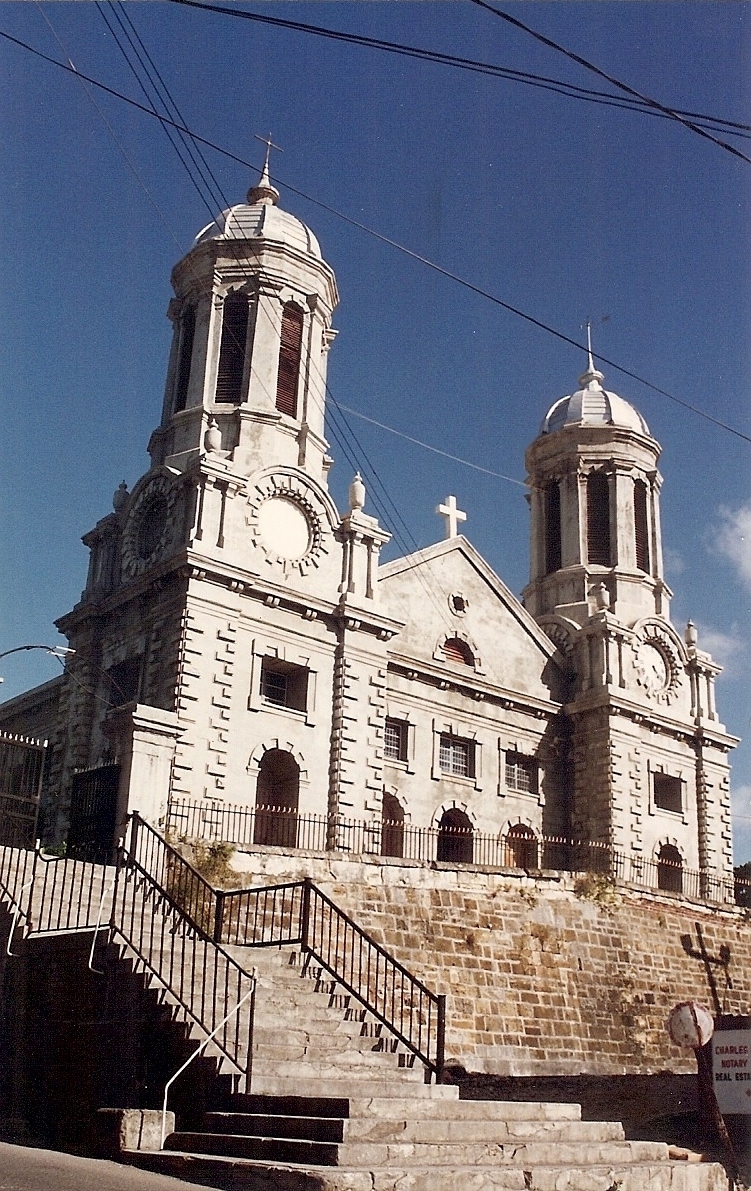
St John's Anglican Cathedral

St John's Anglican Cathedral
The Anglican Cathedral of St. John the Divine, St. John's, Antigua, West Indies

Friday, July 22, 2011

East Gable Wall

We are going to have to restore the East gable wall.  This wall sits directly over the sanctuary.

East Gable Wall above the Sanctuary
The inner face of this wall is lined with concrete.  This is probably work from a previous restoration.  However the stones are supported by a wooden beam that is sagging.
Timber Beam Supporting the Wall Stones over the Sanctuary

Sagging Beam
Since there is no way to replace the beam and still support the stones above, this wall will also have to be dismantled.

Thursday, July 14, 2011

A Raisin In The Sun

Dream Deferred

What happens to a dream deferred?
Does it dry up
Like a raisin in the sun?
Or fester like a sore–
And then run?
Does it stink like rotten meat?
Or crust and sugar over–
like a syrupy sweet?
Maybe it just sags
like a heavy load.
Or does it explode?
~ Langston Hughes
It has been awhile since I last posted anything on the spirit of this Restoration (What does the restoration mean to you? ).  The motivation behind this Restoration is extremely important.  Behind the technical decisons, material procurement and the execution of construction tasks, lies the need for funds to purchase these goods and services.  It is impossible to have successful fund raising without the necessary motivation.  Especially in these recessionary times. 

I am moved to write this post because I read an article published at Caribarena, a newsportal.  The article,Students Look Back In Time, was written by some students and speaks to the sad fact that far too many historical buildings around St. John's have not been restored and have in fact been demolished.  What caught my eye in the comments posted by readers of the article was one made by one person who stated,

"They (some of the historical buildings and sites) were constructed and owned by the oppressors of our ancestors, who tortured, abused and treated them in the most inhumane of ways. As far as I am concerned, I want any vestige of these monsters removed from my country. This is our country now and we need to build our own history and forever rid ourselves of that of the British. Then we will have something we can proudly call our own, and our grandchildren and great-grandchildren can write articles like this about the buildings we, their kin not their oppressors, built."

I have a gut feeling that this sentiment exists in the conscious and subconscious minds of many Antiguans.  And while the author of the comment above was making it directly about a barracoon (slave holding quarters) that the students found in St. John's, his or her disgust was extended to all things British.  I wondered, could sentiments like this be obstacles to the Restoration of the Cathedral?

This brings me to the title of this post.  We the descendants of a slave holding society have a number of issues to resolve.  Chiefly how do we regard our history?  The truth is that considering the fact that just as much British "blood" flows in our veins as African "blood," we cannot escape the fact that we cannot discard one for the other.  We speak a British language, model our government systems and business systems after them and our values and beliefs are British in origin.  And that creates a tension within us. 

I believe that this tension left unresolved is drying up our motivation like a raisin in the sun.  Or maybe it is festering like a sore.  Sagging under a heavy load.  Unresolved feelings be they deferred dreams or anger over the past is detrimental to an person's or people's well being.  Maybe this Restoration will provide us an opportunity to resolve these feelings.  Something to pray about.

Wednesday, June 29, 2011

Missing Bricks

We are in the process of demolishing the West gable wall.  This was due to the appearance of significant cracks on the outside and loosened stones on the inside.  I have noticed that where the brick lining is missing is where the damages have appeared. 
West Gable Wall
You will notice, in the picture above, when you click on it and enlarge it, that there is a crack that runs from top, where the cross is, down through the circular and semi-circular openings.
West Gable Wall from the inside
You will see from this picture above that the West gable wall is not brick lined like the North gable wall pictured below.
North Gable Wall

North Gable Wall Exterior
The deterioroation of the stones in the picture above is due to the portland cement wash on the exterior stones.  Since it is not porous it has caused the deterioration of stones all over the exterior of the Cathedral.  There are no structural cracks in this wall.

The inside of the West gable wall is lined with bricks except for one place.  The stones in this place have become loose and buckled inward.

Brick lined West gabled wall
Section of West gabled wall where stones have become loose and where the brick lining is also missing

Stone and Brick Walls

The outter stone walls of the Cathedral are made of stone and are lined with bricks.  We have seen this in  many places.  This is apparently a common feature of stone walls.

Even in the heart of stone-districts bricks are now generally used for all internal walls, and for all but the facing of external walls. Their cheapness, and the facility with which they can be laid, have led to their adoption .....
.......external walls ......consist of an outer skin of stone ..... and an inner lining of .....brick,  ...These walls have usually one stone through in every square yard, ....

Stone wall with through stone (A)
Sometimes, however, cast or wrought iron ties are used instead of through-stones...

Stone wall with brick lining bonded by wrought iron ties

West Gable Wall showing wrought iron tie
For larger buildings, ...thicker walls should be used. This gives an opportunity for substituting bond-stones as at A (See Figure below) for the through-stones previously mentioned, and the brick lining may be tied to the body of the wall either by inner bond-stones as B, or preferably by rows of headers every fourth or fifth course as at CC.1
 

Brick lined stone wall with outter bond stones (A), inner bond stones (B) and brick headers (C,C)
North Gable Wall with bond stone showing around the window arch
1G. Lister Sutcliffe, The Principles And Practice Of Modern House-Construction (Blackie & Son Ltd, 1900)


Thursday, June 23, 2011

West Gable Wall cont'd.

Demolition continues.
A vanishing wall
 We were hoping to stop at the decorative edge above the windows but judging from the damages we are seeing inside, we may have to go down to the window lintels.
Demolition debris

The remains of the cross
We now see just how rotten the inside of the wooden cross was.  I have a sentimental attachment to this cross.  After the 1974 earthquake the Cathedral was damaged and we were not allowed to re-enter it for some time.  From the outside the damage was not visible but the cross piece of this cross had fallen off.  The abscence of it indicated to me that the Cathedral was still damaged and the reattachement that repairs had been made.   I feel like I am saying goodbye to an old friend.  This object has done its duty and will now be discarded.  Thanks be to God, what it symbolises remains in our hearts.  " ...the wonderous Cross whereupon all human service and sacrifice find their highest consecration." (Archbishop Edward Hutson, 3rd May 1936)
The Cathedral under repairs possibly after the 1974 earthquake

Tuesday, June 21, 2011

West Gable Wall

This wall is an important feature in the iconic images of the Cathedral.  It sits between the twin towers and supports at its peak a wooden cross.

Yet like so many features on this Cathedral it too is falling apart.  Cracks have appeared between the circular and semicircular openings and one can look through the wooden cross in some spots.  Truth be told the wooden cross has been leaning a little back for months.  I shifted it when I held on to it for support the first few times I climbed over the roof.  The cracks are all the way through the brick lining in the inside and in some places the stones have buckled.  Needless to say it has to come down.  Demolition started today.


Cross showing extreme wood rot

Wall sans cross showing the crack that runs through both openings

Though hard to see in this photo, the stones between the first two columns are sagging

New Roof

Pictures of the underside of the new roof.


 The red metallic band are the new straps that had to be installed to accomodate the newer beams that are 1 inch thicker in some places.


An excellent persepctive of the trusses that make up the cathedral roof